 |
“A lot of is” or “a lot of are” in English
The usage of singular and plural verbs in English is sometimes more complicated than in other languages. One example of this phenomenon is (...)
November 8, 2013 – Jakub Marian – English
|
 |
‘He or she’ vs. ‘they’ in English
Traditionally, in English, when you had to use a pronoun for a person whose sex was unknown because it had been previously referred to as (...)
November 5, 2013 – Jakub Marian – English
|
 |
‘Auf der Webseite’ or ‘an der Webseite’ in German
One of the trickiest parts in language learning is translation of prepositions. In German, when there’s something written on a website, (...)
November 4, 2013 – Jakub Marian – German
|
|
|
“Fast” / “fastly” / “quickly” in English
Many English learners use the word “fastly” as an adverbial form of “fast”, which seems quite logical because this is the way adverbs are (...)
August 22, 2013 – Jakub Marian – English
|
|
|
Pronunciation of English prefixes and suffixes
There are a few English prefixes and suffixes that are an especially common source of pronunciation errors, mostly because they would be (...)
July 25, 2013 – Jakub Marian – English
|
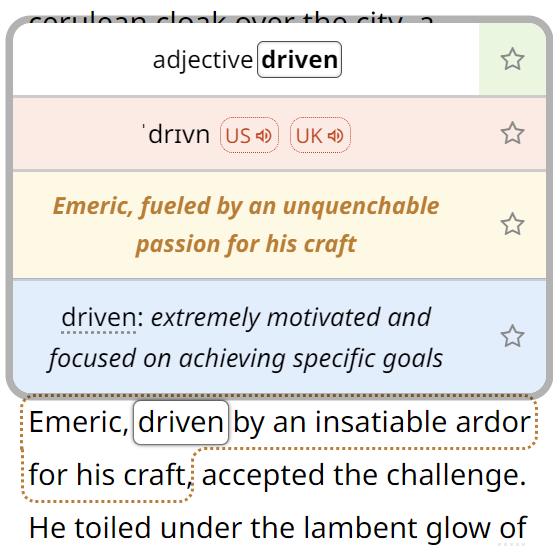
By the way, have you already seen my brand new web app for non-native speakers of English? It's based on reading texts and learning by having all meanings, pronunciations, grammar forms etc. easily accessible. It looks like this:
 |
English words that have two possible pronunciations
There are many English words that are spelled the same but pronounced differently. Such words are called heteronyms (more loosely also (...)
July 15, 2013 – Jakub Marian – English
|
|
|
I look forward to hear/hearing from you
The phrase “look forward to” differs from other verbs followed by “to”. This article explains in detail how to use it correctly. (...)
July 11, 2013 – Jakub Marian – English
|
|
|
Common pronunciation errors in English
We all have a mother tongue which functions as a filter for what sounds we are able to distinguish. When you learn a foreign language, you (...)
May 28, 2013 – Jakub Marian – English
|
|
|
‘Arrive to’ vs. ‘arrive in’ vs. ‘arrive at’ in English
Because of the influence of verbs like “come to”, “move to”, and “go to”, learners of English often tend to use the combination “arrive” + (...)
April 4, 2013 – Jakub Marian – English
|
 |
How to learn a foreign language: Familiarization
Familiarization is a language learning method applicable only to languages that are not closely related to a language I already know, (...)
February 2, 2013 – Jakub Marian –
|