
 |
‘Dwarves’ or ‘dwarfs’ – which spelling is correct?
It may come as a great surprise to the fans of The Lord of the Rings, but the correct traditional spelling of the plural of “dwarf” is (...)
May 6, 2015 – Jakub Marian – English
|
 |
‘More better’ is not always wrong (but usually it is)
The comparative degree (“more of something”) of monosyllabic adjectives is usually formed by adding -er at the end of the adjective, (...)
May 3, 2015 – Jakub Marian – English
|
 |
Words ending with -ung are feminine in German
There are over 20,000 nouns in German that end with -ung, so if there is a rule that applies to them all, it is definitely worth learning. (...)
May 3, 2015 – Jakub Marian – German
|
|
|
German suffix -ant: masculine nouns
There are over 300 nouns in German that end with “ant”, and almost all of them are masculine (i.e. they have the article “der”), such (...)
May 1, 2015 – Jakub Marian – German
|
|
|
‘I am agree’ vs. ‘I am of agreement’ vs. ‘I agree’ in English
Saying “I am agree with you” is a common error among native speakers of Romance languages. For example, when you want to say that you (...)
April 30, 2015 – Jakub Marian – English
|
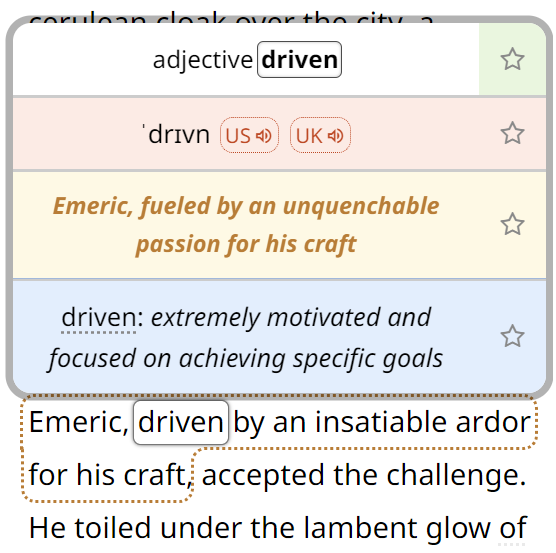
By the way, have you already seen my brand new web app for non-native speakers of English? It's based on reading texts and learning by having all meanings, pronunciations, grammar forms etc. easily accessible. It looks like this:
|
|
‘I just did it’ vs. ‘I have just done it’ – present perfect or past simple?
The traditional (but now somewhat outdated) rule dictates that “just” is to be used with the present perfect, not the past simple, as (...)
April 26, 2015 – Jakub Marian – English
|
|
|
Nouns ending with -heit and -keit in German
All German nouns that have the suffix -heit or -keit are feminine (i.e. have the article die), without exception (which is something we (...)
April 25, 2015 – Jakub Marian – German
|
|
|
Comma before ‘that’ and ‘which’
What distinguishes English from most other languages is its use of commas before a dependent (subordinate) clause. Dependent clauses (...)
April 22, 2015 – Jakub Marian – English
|
 |
Improve your English vocabulary and grammar with The Cask of Amontillado
The cask of Amontillado is a famous short story by Edgar Allan Poe. However, this story of cold-blooded revenge will not only give you (...)
April 19, 2015 – Jakub Marian – English
|
|
|
Difference between ‘go’ and ‘walk’ in English
When you travel from one place to another, most languages require that you use a verb based on how you travel, such as “walk” (which means (...)
April 18, 2015 – Jakub Marian – English
|