 |
Comma before ‘because’ in English
“Because” introduces a dependent clause that almost always contains essential information (the whole sentence would sound incomplete (...)
August 31, 2015 – Jakub Marian – English
|
|
|
Comma before ‘and’, ‘but’, ‘so’, etc., between independent clauses
Most languages don’t require a comma before “and” when it joins two independent clauses, but writing a comma before “but”, (...)
August 24, 2015 – Jakub Marian – English
|
|
|
Present perfect with a specific time in the past
The present perfect expresses the idea of “an action that was finished at some unspecified point in the past”. Saying “I have done (...)
July 1, 2015 – Jakub Marian – English
|
 |
Difference between economics, economy, economic, and economical
The economy is, according to the Oxford Learner’s Dictionary, “the relationship between production, trade and the supply of money in a (...)
June 18, 2015 – Jakub Marian – English
|
|
|
Advice or advices – singular or plural?
Slightly surprisingly, “advice” is an uncountable (mass) noun in English (like “water” or “sand”), and as such it has no plural (...)
June 13, 2015 – Jakub Marian – English
|
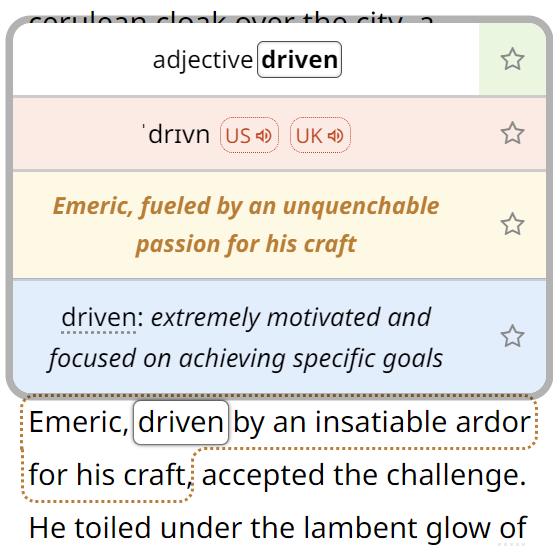
By the way, have you already seen my brand new web app for non-native speakers of English? It's based on reading texts and learning by having all meanings, pronunciations, grammar forms etc. easily accessible. It looks like this:
|
|
Nouns with identical singular and plural forms
English is, thankfully, not a very irregular language when it comes to nouns. The vast majority of nouns form the plural by simply adding (...)
June 12, 2015 – Jakub Marian – English
|
|
|
‘More better’ is not always wrong (but usually it is)
The comparative degree (“more of something”) of monosyllabic adjectives is usually formed by adding -er at the end of the adjective, (...)
May 3, 2015 – Jakub Marian – English
|
|
|
Comma before ‘that’ and ‘which’
What distinguishes English from most other languages is its use of commas before a dependent (subordinate) clause. Dependent clauses (...)
April 22, 2015 – Jakub Marian – English
|
A small but necessary interruption: This website does not contain any ads and is completely dependent on the support of its readers. If you enjoy reading articles here, please, consider helping by using my web app for English learners.
|
|
‘Many’, ‘much’, ‘a lot of’, and ‘lots of’ in English
These four phrases, “many”, “much”, “a lot of”, and “lots of”, all express a similar idea of a large amount of something, but they are not (...)
August 24, 2014 – Jakub Marian – English
|
|
|
‘Lend’ vs. ‘borrow’ in English
The verbs “lend” and “borrow” are among the most commonly confused words in the English language. Why? Because they are often translated (...)
August 4, 2014 – Jakub Marian – English
|