 |
“Look good” or “look well” in English
Sentences with the verb “look” (in the sense of “appear, seem”) have a different structure from what many English learners think. “Look” (...)
July 27, 2014 – Jakub Marian – English
|
|
|
‘All but’ vs. ‘anything but’ vs. ‘everything but’ in English
These three expressions, “all but”, “anything but”, and “everything but”, are among the most confusing in the English language for native (...)
March 28, 2014 – Jakub Marian – English
|
 |
English words in which ‘ss’ is pronounced as ‘z’
In French, Italian, German and some other languages that use the Latin alphabet, the spelling difference between “s” and “ss” is used to (...)
February 6, 2014 – Jakub Marian – English
|
|
|
‘Learnt’ vs. ‘learned’ in English
Both “learned” and “learnt” are considered correct as the past tense and past participle of “learn”. However, take a look at the following (...)
January 15, 2014 – Jakub Marian – English
|
|
|
“How / what does it look like” in English
One thing I keep reading on the Internet is the expression “How does it look like?” Sadly, this sentence doesn’t make any sense. The (...)
January 7, 2014 – Jakub Marian – English
|
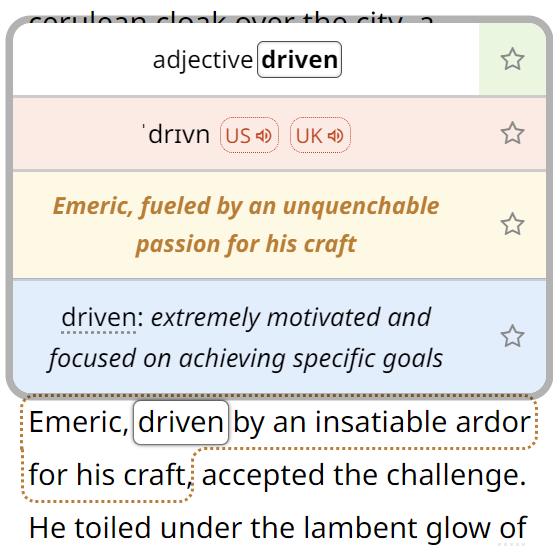
By the way, have you already seen my brand new web app for non-native speakers of English? It's based on reading texts and learning by having all meanings, pronunciations, grammar forms etc. easily accessible. It looks like this:
|
|
“Information is” / “informations are” – is information plural or singular in English?
This is one of the most common mistakes among English learners. There’s nothing wrong with saying “Informationen” in German or (...)
December 3, 2013 – Jakub Marian – English
|
|
|
“News is” or “news are” – singular or plural?
Several English words end with an “s” in their singular form. Most of these don’t pose any problem; few people would say “the kiss were (...)
November 30, 2013 – Jakub Marian – English
|
|
|
“Would of” in English
The expression “would of” is a common mistake. People who learn English mainly by ear (including many native speakers, unfortunately) (...)
November 24, 2013 – Jakub Marian – English
|
|
|
“Aren’t I” / “amn’t I” / “am I not” in English
When you ask an affirmative question at the end of a sentence, you are supposed to use the contracted version of a verb. For (...)
November 23, 2013 – Jakub Marian – English
|
|
|
English verbs that are the same in the present tense and in the past tense
Most of the commonly used English verbs are irregular. If the past tense and the past participle differ from the present tense, it is (...)
November 10, 2013 – Jakub Marian – English
|